I've lived around horses my whole life. They're fun and amazing, but they can be dangerous if you aren't careful. My Website explains how to read your horses'
body language, which can save lives, if you don't heed your horses warnings you can end up being kicked or bitten.
I'll also cover how to react to your horse's warning signs and information about riding, grooming and more.
One of the most important things to be able to tell is if your horse is tense. If your
horse is tense it may kick or bite if it's pushed too far.
If your horse is tense it won't be resting a hind leg, it's lower lip won't be droopy
and it's muscles may look tense. It may also have it's ears back, be stomping a
hoof and it may throw it's head up if you try to pat it, which is also a sign of being head shy.
Head Shy is where the horse is nervous of having it's head touched, which can
happen if it's been hit on the head, or people have moved suddenly towards it's head.
You also need to be able to tell if your horse is relaxed.
Resting a hind leg, droopy lower lip, head lowered and relaxed are all signs of relaxtion.
An alert horse will often have it's head up, ears pricked, and nostrils flared are sighs of an
alert horse.
If your horse has one ear back and one forwards it's listening to something, if it's ears are
flicking back and forwards it's probably trying to locate a sound.
A scared horse will be tense, it's ears probably back and the whites of it's eyes may be showing.
If you corner a scared horse it might lash out at you because it feels trapped.
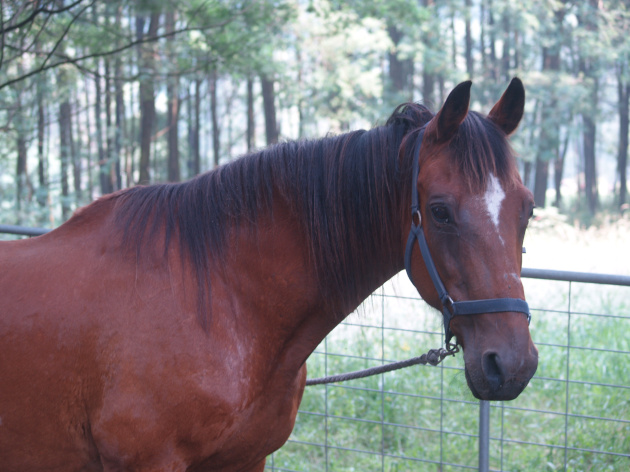
Your horse also makes noises. If your horse is running up and down the fence neighing loudly
it probably means they can't find their paddock mate, if they are kept with other horses. It
usually means they are lonely.
Horses also make a low, throaty nicker which can show happiness, they might make it when you
come over with they're food.
A snort can show alarm (if it's short) or pleasure (if it's a longer snort and the horse bends
it's head downwards).
Horses often squeal if they're meeting a horse for the first time, often two stallions
will squeal when they meet, or bossy mares.
Here's a list of big no-nos around horses, for the person, and horse's safety.
And here's a list of some things you should do around horses, for your safety, and the horse's safety, too.
Those are some of the main things to do and not do horses are prey, so they are naturally afraid of things sneaking up on them.
Horses often don't want to be caught, they run off or hide or just go to the far corner of their
paddock so you have to walk all that way to catch them.
It can be a pain. If you are in a hurry it's likely to be worse, too.
Here's a way to make catching your horse easier.
If the other horses in the paddock are bossy to the horse you ride you may need someone to come and hold the bossy horse while you get your horse out.
First thing is to find a good spot to tie the horse up in. A flat area with plenty of room if
your horse decides to swing its rump around is good. You need a solid thing to tie your horse
to, a post, tree, or a solid gate work fine. Make sure it's sturdy and can't be pulled over or
anything. Attach some bailing twine to the solid thing (gate, tree or post) and make a loop that you
can attach the lead rope to. You use bailing twine so if the horse pulls back hard the twine snaps,
that way your horse's halter doesn't get broken or the horse doesn't get hurt.
We use a knot called a quick release knot to tie the horse to the bailing twine. That why if
the horse gets upset you can just untie the knot quickly to stop your horse hurting itself.
Grooming your horse is not only to make them clean, but to check for injuries, also, if you
just put the saddle on a muddy coat your horse would get all sore.
First using a dandy brush (stiff bristled brush) you clean the dirt off. Once you've got the mud
off, use a body brush to continue cleaning, pay special attention to the saddle arena and girth
area.
Next gently brush the face, clean any mud off (using a body brush) be careful not to poke them
in the eye.
Then clean out the hooves with a hoof pick. Standing at the shoulder, run your hand down the horse's
leg. When you reach the fetlock (ankle) squeeze gently and push the horse's weight away from
you with your shoulder. When they lift their hoof clean out the mud, working from heel to toe,
avoid digging into the frog in the centre of the horse's hoof. Once the hoof is clean, clean the other
hooves out.
Tacking up is where you put the gear (saddle and brilde) on your horse.
After you groom your horse, put the saddle blanket on, make sure it's wrinkle free
and a little further forwards than it'll be once you are finished.
The saddle is next. Lift it gently onto the horse's back, making sure not to
bang it down hard. Before you put the saddle on, run the stirrups up, and put the girth over the saddle.